

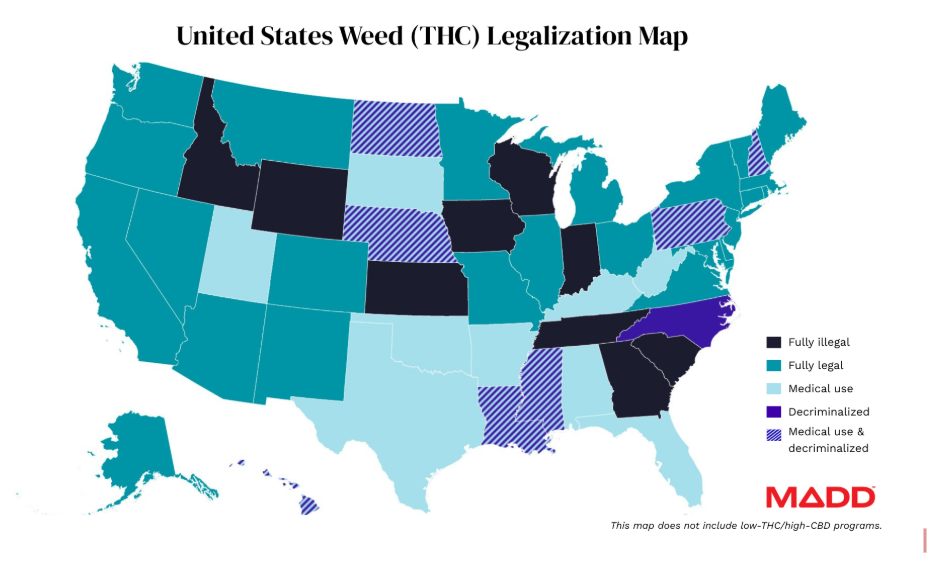
Marijuana (weed) is legal in several states across the United States, but the rules vary widely depending on where you live. As of spring 2026, 24 states and Washington, D.C., have legalized weed for adult recreational use, while 40 states allow it for medical purposes. This page breaks down the law in every state, answers the most common questions about legalization, and covers what responsible, legal use actually looks like.
Table of Contents:
- Legalization of Weed Map
- State-by-State Weed Laws
- Weed Legalization FAQs
- Tips for Safe, Legal Consumption
Legalization of Weed Map
Laws surrounding cannabis in the United States are a patchwork, and it changes frequently. The weed legality map below offers a snapshot of where it is recreationally legal, medically legal, decriminalized, or still prohibited as of May 2026. States fall into four general categories: full adult-use legalization (recreational and medical), medical only, decriminalized without a legal market, and fully prohibited.
Because legislatures, ballot initiatives, and court decisions can shift a state’s status at any time, always verify the current rules with your state’s official government website or a licensed attorney before making decisions based on this information.
As cannabis laws continue to change across the U.S., understand how THC and CBD affect you differently.
State-by-State Weed Laws
Cannabis legality varies significantly across the country, with possession limits, dispensary access, qualifying conditions for medical programs, and DUI enforcement standards. The table below is designed to help you quickly identify where each state stands, from states with recreational weed legalized to states with medical access only. It’s important to note that recreational legalization includes medical access by definition, and a “Yes” in the decriminalized column does not mean cannabis is legal; it means small-possession offenses carry reduced or non-criminal penalties.
This data is based on THC legalization and does not include CBD oils with low concentrations of THC. Laws are current as of May 2026. Always verify with official state sources, as laws change frequently.
| State | Medical | Recreational | Decriminalized |
| Alabama | Yes | No | No |
| Alaska | Yes | Yes | Yes |
| Arizona | Yes | Yes | Yes |
| Arkansas | Yes | No | No |
| California | Yes | Yes | Yes |
| Colorado | Yes | Yes | Yes |
| Connecticut | Yes | Yes | Yes |
| Delaware | Yes | Yes | Yes |
| District of Columbia | Yes | Yes | Yes |
| Florida | Yes | No | No |
| Georgia | No | No | No |
| Hawaii | Yes | No | Yes |
| Idaho | No | No | No |
| Illinois | Yes | Yes | Yes |
| Indiana | No | No | No |
| Iowa | No | No | No |
| Kansas | No | No | No |
| Kentucky | Yes | No | No |
| Louisiana | Yes | No | Yes |
| Maine | Yes | Yes | Yes |
| Maryland | Yes | Yes | Yes |
| Massachusetts | Yes | Yes | Yes |
| Michigan | Yes | Yes | Yes |
| Minnesota | Yes | Yes | Yes |
| Mississippi | Yes | No | Yes |
| Missouri | Yes | Yes | Yes |
| Montana | Yes | Yes | Yes |
| Nebraska | Yes | No | Yes |
| Nevada | Yes | Yes | Yes |
| New Hampshire | Yes | No | Yes |
| New Jersey | Yes | Yes | Yes |
| New Mexico | Yes | Yes | Yes |
| New York | Yes | Yes | Yes |
| North Carolina | No | No | Yes |
| North Dakota | Yes | No | Yes |
| Ohio | Yes | Yes | Yes |
| Oklahoma | Yes | No | No |
| Oregon | Yes | Yes | Yes |
| Pennsylvania | Yes | No | Yes |
| Rhode Island | Yes | Yes | Yes |
| South Carolina | No | No | No |
| South Dakota | Yes | No | No |
| Tennessee | No | No | No |
| Texas | Yes | No | No |
| Utah | Yes | No | No |
| Vermont | Yes | Yes | Yes |
| Virginia | Yes | Yes | Yes |
| Washington | Yes | Yes | Yes |
| West Virginia | Yes | No | No |
| Wisconsin | No | No | No |
| Wyoming | No | No | No |
Just because THC is legal in some states doesn’t mean its effects disappear quickly. Learn how long it can stay in your system to make safer, informed decisions.
Weed Legalization FAQs
How many states have legalized weed?
This answer depends on how you define “legalized.” As of 2026, 24 states and Washington, D.C., have legalized adult recreational use, meaning adults 21 and older can purchase and possess cannabis without a medical card. Separately, 40 states allow medical cannabis for patients with qualifying conditions.
What states are legalizing weed recreationally?
Several states are actively pursuing recreational legalization in 2026, but proposals and enacted laws are two different things. Currently, Pennsylvania is viewed as the most likely candidate for adult-use legalization, and Idaho has an active medical cannabis ballot campaign. On the opposite end, Florida and New Hampshire recently failed to pass additional legal usage. Any of these situations could change, but until a bill is signed into law or a ballot measure passes, a state’s cannabis remains restricted to whatever its current law allows.
Is it legal to smoke weed and drive?
No, driving while impaired by cannabis is illegal in every state in the country, regardless of whether cannabis itself is legal there. Cannabis affects reaction time, coordination, and judgment in ways that make driving dangerous. Penalties for driving under the influence of marijuana range from fines and license suspension to jail time, and they escalate sharply with repeat offenses or crashes.
No matter the substance, impaired driving is dangerous and puts everyone at risk. Learn more about the dangers of drugged driving.
Tips to Practice Safe, Legal Consumption
If you live in or are visiting a recreational weed state, following the law means more than just buying from a licensed dispensary. The following tips can help ensure you’re practicing safe and legal consumption:
- Always stay within your state’s possession limits, which typically range from 1 to 3 ounces for recreational users.
- Know where it’s legal to consume. Most states prohibit public use, and smoking in a car (even parked) can result in a citation or DUI charge if impairment is suspected.
- Keep all cannabis products secured and out of reach of children, and store them in their original, child-resistant packaging when possible.
- Never drive after consuming cannabis. This applies to recreational users and medical patients alike. If you are hosting others who are consuming, plan ahead by arranging designated drivers, rideshare services, or overnight accommodations.
Laws vary by state, so when in doubt about any local rule, consult your state’s official cannabis regulatory authority or a licensed attorney. Legal access to cannabis does not eliminate personal responsibility; it increases it.
Help End Impaired Driving with MADD
MADD has spent decades working to end impaired driving and support the victims and families it devastates. As cannabis legalization continues to spread across the country, MADD’s mission has never been more important. Cannabis-impaired driving is a serious and growing public safety concern, and MADD is committed to ensuring that legal access to cannabis never becomes a license to put lives at risk behind the wheel.
You can be part of the solution. Whether you donate to support victim services and advocacy programs, volunteer at your local MADD office, or simply commit to never driving impaired, your actions matter. Join MADD in the fight to make our roads safer for everyone.
