

Contact: Becky Iannotta
202.600.2032 / [email protected]
[email protected]
June 25, 2026
New MADD Report Recommends Legislative Updates to State Laws
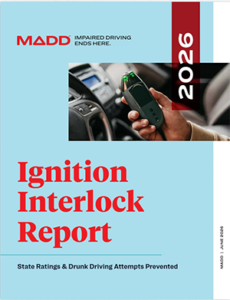 WASHINGTON (June 25, 2026) — Mothers Against Drunk Driving (MADD) today released a new report showing that ignition interlocks have prevented more than 5.7 million attempts by alcohol-impaired drivers to start their vehicles over the past two decades. The report also grades each state’s ignition interlock law, finding that half the nation still has dangerous gaps that allow drunk driving offenders to avoid these lifesaving devices.
Nationally, the average state earned a failing grade, highlighting widespread loopholes that allow DUI offenders to regain driving privileges without installing an ignition interlock. These findings come as drunk driving deaths remain elevated nationwide, increasing 17 percent from 2019 to 2024.
Ignition interlocks are small in-car breath-testing devices connected to a vehicle’s ignition system following a drunk driving arrest or conviction. If the device detects alcohol above a pre-set limit on the driver’s breath, the vehicle will not start. Currently, 34 states and Washington, D.C., require ignition interlocks for all drunk driving offenders.
In 2025 alone, ignition interlocks blocked more than 336,000 attempts by drivers with a breath alcohol concentration (BAC) of .08 or higher—the legal limit in every U.S. state except Utah, where the limit is .05. That is an average of 922 every day or one every 95 seconds.
“MADD has long recognized that technology can play a vital role in preventing impaired driving before it happens,” said MADD CEO Stacey D. Stewart. “This report demonstrates that ignition interlocks are one of the most effective tools available to stop repeat offenses and reduce risk on our roads. Each prevented start represents a drunk driving crash that may never happen, an injury that may never occur, or a life that may never be lost.”
MADD supports laws in every state requiring ignition interlocks for all convicted drunk drivers, including first-time offenders, for a minimum of six months. Ignition interlocks allow offenders to continue driving to work, school, and other essential destinations while ensuring they remain safe and sober behind the wheel. By preventing impaired driving attempts, these devices promote accountability while enhancing public safety.
The report assigns each state a letter grade based on five key policy criteria:
- All-Offender Requirement: All convicted drunk driving offenders must install and use an ignition interlock before unrestricted driving privileges are restored.
- No “Wait-Out” Provision: Drivers cannot simply wait out a suspension period; restoration of driving privileges requires successful participation in an ignition interlock program.
- Compliance-Based Removal: Interlocks may be removed only after drivers demonstrate a sustained period of compliance without attempts to drive after drinking.
- Availability During License Suspension: Drivers may begin using an ignition interlock immediately after arrest or conviction.
- BAC Test Refusals: Drivers who refuse a BAC test are required to complete an ignition interlock program before regaining unrestricted driving privileges.
The state grades are intended to encourage legislative action and highlight proven policies that reduce impaired driving. The report recognizes that prosecutors, law enforcement agencies, highway safety officials, and state administrators must enforce the laws enacted by state legislatures.
Ignition interlock stop data was collected from manufacturers and service providers across the country, with state-by-state results included in the report. The findings show that ignition interlocks remain underutilized in states with weaker laws or loopholes that allow impaired drivers to avoid installation requirements.
“Strong ignition interlock laws save lives,” said Stewart. “States that require these devices for all offenders and close existing loopholes are taking meaningful steps to prevent repeat drunk driving and protect everyone on the road.”
Research shows that ignition interlocks reduce repeat offenses by 67%, and states requiring the devices for all offenders experience a 26% reduction in drunk driving deaths.
Eleven states and the District of Columbia received an A:
- Arizona
- Arkansas
- Colorado
- Connecticut
- Delaware
- District of Columbia
- Kansas
- Maryland
- New Mexico
- Oklahoma
- Tennessee
- Washington
At the other end of the scale, 24 states and Puerto Rico received an F:
- Alabama
- California
- Florida
- Georgia
- Indiana
- Maine
- Massachusetts
- Michigan
- Minnesota
- Missouri
- Montana
- Nebraska
- New Hampshire
- North Carolina
- North Dakota
- Ohio
- Oregon
- Pennsylvania
- Puerto Rico
- Rhode Island
- South Carolina
- South Dakota
- Texas
- Wisconsin
- Wyoming
MADD representatives are available for interviews. For the full report and more information visit https://madd.org/ignition-interlocks/.
About MADD
Mothers Against Drunk Driving® (MADD) is a national nonprofit leading the movement to end impaired driving for good. Since 1980, MADD has helped reduce drunk driving deaths in America by more than 51%, saved nearly 500,000 lives, and served nearly one million victims and survivors. The organization is committed to leading prevention efforts with young adults, collaborating with law enforcement to keep our roads safe from impaired drivers, as well as advocating for stricter sentencing and stronger laws, including the HALT Drunk Driving Law that mandates anti-drunk driving technology in every new car. MADD continues to provide support services to victims and survivors of impaired driving at no charge through victim advocates and the 24-Hour Victim Help Line 1-877-MADD-HELP. For more information or to donate, visit https://madd.org/ and follow MADD on Facebook, Instagram, Twitter, TikTok, LinkedIn, and YouTube
